
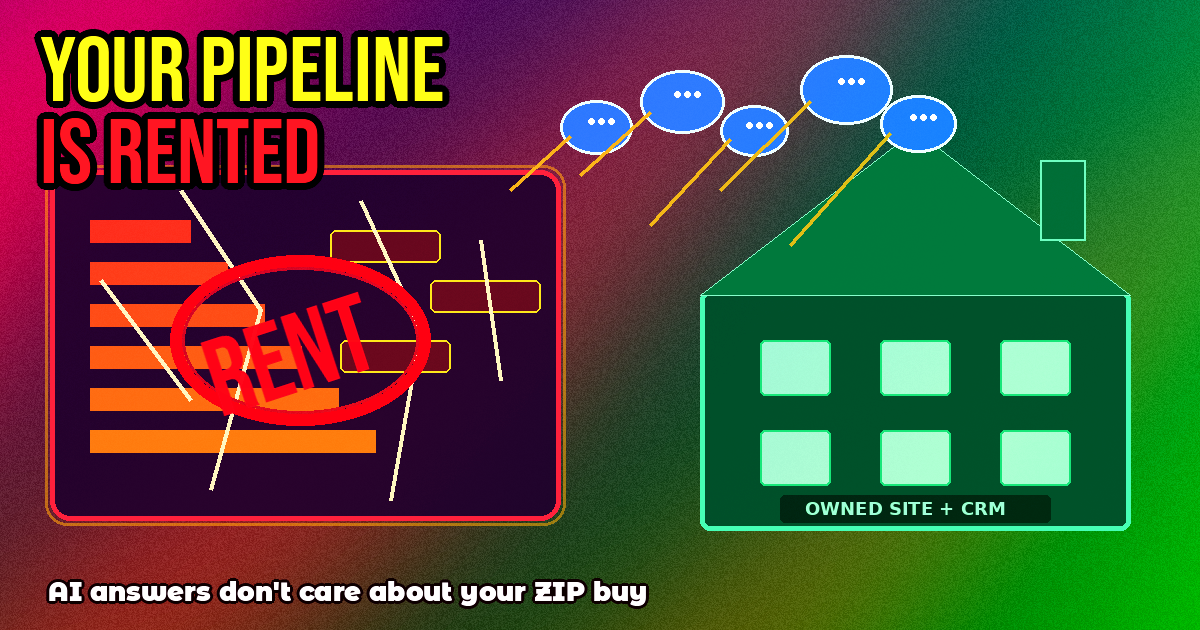
Josh Ries published a clean diagnosis on Inman today: Why lead source dependence is killing real estate businesses. One portal, one paid ZIP, one referral feed. It feels like a system until the price moves, the inventory thins, or the platform changes the rules. Then you learn you were renting opportunity instead of owning pipeline.
I agree with the thesis. I want to push it one layer further from the operator seat. Lead-source dependence does not only break when a portal raises rates. It breaks when answers and local intent move, and they are already moving.
Who
This is for agents and team leads who can name their primary lead source in one word, and who quietly worry what happens if that word stops producing.
Not a growth-hack audience. Operators who care about cost per closing, message control, and whether next month's pipeline exists if one vendor disappears.
What
Ries's three failure modes still hold. You lose control of strategy, profitability, and scale when one company owns the opportunity layer. The fix he names is a lead generation portfolio: channels with different jobs (now business, future pipeline, trust, retargeting, database presence).
The durable layer under that portfolio is boring on purpose:
- an owned site you control (pages, offers, schema, speed, forms)
- structured content that search engines and answer engines can actually use (local pages, FAQ blocks, entity-clear service and area copy, not blog sludge)
- a CRM + nurture path that keeps the lead after the click, so follow-up is yours
Portals and paid can still sit in the mix if the unit economics work. They just stop being the operating system.
Where
Dependence shows up in the stack, not the slogan:
- Google Business Profile and local pack presence you can update without a vendor ticket
- site + local SEO that maps to real markets and inventory conditions (Ries's point: Oregon and New York do not need the same message)
- AEO / GEO inputs you can inspect (crawlable HTML, clear answers, supported claims, structured data) without pretending anyone can guarantee an AI citation
- reviews and listing reputation surfaced where buyers already compare (Birdeye is one reviews and listings tool some teams use; the work is still yours to run)
- CRM stages that separate "now business" from "future pipeline" so every month does not restart at zero
If your "marketing system" is a login to someone else's dashboard, that is access. It is not a system you own.
When
The pressure increases when buyers ask answer engines and local surfaces first, and when portal economics tighten after you are dependent. Ries already lived the ZIP-availability ceiling: growth limited by what the platform would sell, not by what the team could execute.
You do not wait for a price hike to diversify. You assign roles while the rented channel still pays, so a change is a reweight instead of a crisis.
Why
Portals optimize for their marketplace. Answer engines optimize for a synthesized reply. Neither is obligated to protect your margin.
Owned site + structured content + CRM is the layer that still compounds when:
- a portal reprices or throttles inventory
- an AI overview steals the click you used to buy
- local intent shifts toward GBP, maps, and short answer-shaped pages
Performance-priced pipeline work (pay for outcomes you can measure, not vibes) only works if you can see cost per closing across channels. One rented source gives you an invoice, not a comparison set.
Diversification means knowing which channel buys closings this month, which builds the database, and which earns trust, then instrumenting each one honestly. If a metric is not measured, it is null. It is not a story.
If your top lead source vanished on Friday, which owned asset would still produce a conversation next week (site, GBP, database, or reviews), and what is missing from that list?